A new white paper, Evaluating the Economic Benefits of Nonmotorized Transportation examines potential methods for evaluating the economic benefits from nonmotorized transportation investments: commute cost savings for bicyclists and pedestrians, direct benefits to bicycle and tourism-related businesses, indirect economic benefits due to changing consumer behavior, and individual and societal cost savings associated with health and environmental benefits. This report reviews potential methods for analyzing these different economic benefits at the project, neighborhood, and larger community scale. Download the white paper here.
FHWA Separated Bike Lane Planning And Design Guide
June 23, 2015 by
The Federal Highway Administration (FHWA) recently released its Separated Bike Lane Planning and Design Guide, which you can download here. This guide is the result of two years of research into numerous modern protected bike lanes around the country, in consultation with a team of national experts. Among the many useful images and ideas in the 148-page document is a spectrum of comfortable bike lanes, starting with bike infrastructure that will be useful to the smallest number of people and continuing into the more broadly appealing categories. Download the .pdf here.
Adding New Road Capacity Doesn’t Improve Congestion
March 10, 2015 by
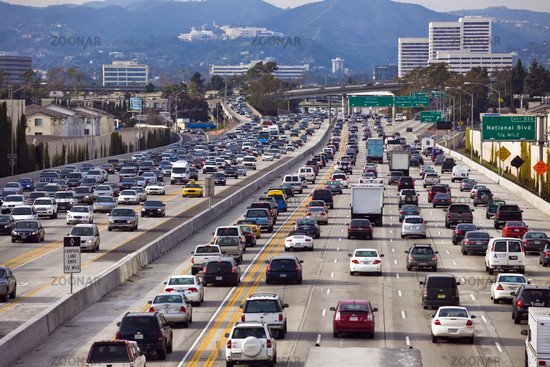 Decades of traffic data across the United States shows that adding new road capacity doesn’t actually improve congestion. The latest example of this is the widening of Los Angeles’ I-405 freeway, which was completed in May 2014 after five years of construction and a cost of over $1 billion.
“The data shows that traffic is moving slightly slower now on 405 than before the widening,” says Matthew Turner, a Brown University economist, in 405 Commutes Now a Minute Worse Than Before Carpool Lane.
The main reason, Turner has found, is simple: adding road capacity spurs people to drive more miles, either by taking more trips by car or taking longer trips than they otherwise would have. He and University of Pennsylvania economist Gilles Duranton call this the “fundamental rule” of road congestion (The Fundamental Law of Road Congestion: Evidence from US Cities) adding road capacity just increases the total number of miles traveled by all vehicles.
In an influential 2011 paper, the two looked at the total capacity of highways in each metropolitan area in the US and compared it with the total number of vehicle miles traveled. They found a one-to-one correlation: the more highway capacity a metro area had, the more miles its vehicles traveled on them. A 10 percent increase in capacity, for instance, meant a 10 percent increase in vehicle miles, on average. To access that paper, click here.
Research Investigates Impacts of Safe Routes To School Programs
January 15, 2015 by
 New research, The Impact of Safe Routes to School Programs on Walking and Biking, highlights findings from studies conducted in several states and cities that have examined walking or biking rates, safety, and economic issues associated with Safe Routes to School. Download the .pdf here. Key findings and recommendations:
• Actively commuting to and from school could improve mental and physical health.
• SRTS has increased the number of students who walk or bike to and from school.
• Unsafe routes make it harder for students to walk or bike to and from school. SRTS has made it safer for students to walk or bike to or from school.
• SRTS can lower health care and transportation costs for school districts and families.
• Communities can take action on SRTS through subdivision regulations that require sidewalks, education facility plans that ensure access to school by foot and bicycle, school wellness policies that include Safe Routs to School, and capital improvement plans that prioritize engineering improvements near schools. Click here for more information about the SRTS research.
WALKABLE COMMUNITIES 4X MORE TAX REVENUE, 41% HIGHER GDP
October 23, 2014 by
 During a panel presentation organized by the REALTOR® University Richard J. Rosenthal Center for Real Estate Studies, realtors learned that residential walkable communities generate four times the tax revenue compared to regional and business malls, bringing more value to the area, according to panelists. “Walkable urban regions in the U.S. have a 41 percent higher Gross Domestic Product over non-walkable regions,” said Christopher Leinberger, professor at George Washington University School of Business and president of Locus, a national coalition of real estate developers and investors who advocate for sustainable, walkable urban development in metropolitan areas. Click here to learn more.
